Showing posts with label google Algorithm updates. Show all posts

Friday, 9 March 2012

Why Google’s Plan To Make Maps Pay For Itself Could Backfire

Google was once satisfied to have its satellite products, like Maps, drive goodwill among startups and create new exposure to their users. But now we’ve heard Google’s new plan is to make these products self-sufficient. It’s begun charging high-volume users of its Maps APIs. Companies like Foursquare and Apple are balking at the price hike and looking to strategically reduce reliance on Google, so they’re switching to OpenStreetMap.
This short-term revenue play could turn into a long-term disaster because OpenStreetMap users have to contribute the improvements they make to its data, so one day it could become better than Google Maps. And who’ll be next to bail on Google’s API? Yelp comes to mind.
Google Maps Goes The Wrong WayThe Google Maps API used to be free, as it was trying to gain popularity and displace MapQuest and Yahoo. At the beginning of March it began charging anyone pulling over 25,000 page loads a day $4, $8, or $10 per additional 1,000 loads, and also now offers Premier Tier. Foursquare and Apple jumped ship, plenty of other big companies might do the same. With it now publicly traded, investors could push Yelp to switch to a free alternative.

Digtal Trends published some great background and analysis on the maps industry this morning. It explains how Foursquare is using a company called MapBox to improve data it pulls from OpenStreetMap, while Apple might use acquired companies including C3 Technologies to add 3D graphics.
This is where Google’s long-term problem emerges. OpenStreetMap, or OSM, is totally free at any volume, but if users improve its data on their own, they have to contribute those improvements back to OSM. If someone augments OSM with satellite, street view, reviews, or other mashups, everyone’s maps benefit. As more big maps users switch to it, it will get better and better, creating a snowball effect where it gets more attractive with time.
While Google has the best maps right now, these contributions mean it might not stay that way. Like crowdsourced Wikipedia usurped traditional encyclopedias, the same could happen with maps. One day even low-volume free clients might switch to OpenStreetMap and end users might prefer it. This could hurt Android, which is Google’s future. The search and ads giant has plenty of ways to make money. Charging for the Google Maps API seems like a wrong turn.

Tuesday, 7 February 2012

Google Chrome Is Now Available For Android (And It’s Fantastic)

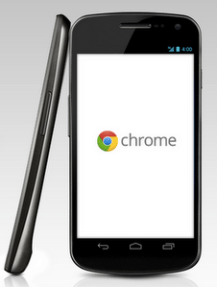
Screen Shot 2012-02-07 at 12.36.36 PMIf you have one of the few Android devices currently running Ice Cream Sandwich, then you’re going to love this post. The rest of you, including those of you on iOS, will have to gaze longingly for a while.
Because Chrome just landed on Android.
It’s faster. It syncs everything (provided you want it to). It has nifty transition effects and a more intuitive system for jumping between tabs. And it’s also loaded with potential.
Google’s Chrome browser, which has skyrocketed to popularity since its debut in 2008 and consistently gets top marks for being the fastest browser in town, has long been strangely absent from Android. To be clear, Android has always shipped with a browser of its own — and it actually shares much of the same codebase with Chrome, including the V8 JavaScript engine. But next to the real Chrome, it’s a clear wannabe. After using it for a day, I really have no intention of using the older browser again.
Unfortunately, as I alluded to earlier, Chrome is only available for Android 4.0 and higher — which means the vast majority of Android users won’t be able to take advantage of it yet (devices that support 4.0 at this point include the Galaxy Nexus, Transformer Prime, Xoom, and the Nexus S). Google says this was done in part because Chrome needs to take advantage of the hardware acceleration features that were introduced in the latest build of the OS. If you have a device that supports it, you can download it right here
.
So what makes Chrome great? Let’s take a look at the features.
The most obvious difference between Chrome and the stock Android browser is the UI.
For one, Chrome comes with the browser’s gray color scheme, rather than the ICS ‘Holo’ styling. Browsing through the app you’ll notice plenty of subtle effects that contribute to the browser generally feeling more polished. Tabs slide in when they open, and fade out when they’re closed, which helps you stay oriented in the app. The ‘all tabs’ button, which includes a number to indicate how many tabs you currently have open, pulls up a ‘stack’ of your open tabs that you can slide around to get a better look at the tab’s content before you actually open it.
Another nice touch: if Chrome notices you’re trying to tap an area that has a dense cluster of links (in other words, you might have trouble tapping the right one), it’ll launch a neat magnifying pane so that can you tap the one you want.
But the changes run far deeper than the UI. My favorite is the support for sync.

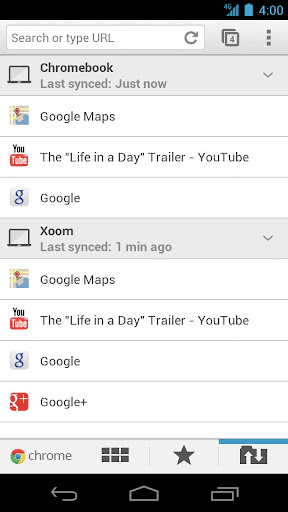
For some time now, the desktop versions of Chrome have allowed you to connect a Google account to your browser, allowing you to sync browser history, bookmarks, apps, autofill, and other data between multiple computers (in other words, if you have a laptop and a desktop machine, you can ensure they’re configured the same way). Now you can hook your Chrome mobile app to your Google account too, and it’ll sync much of the same data (it doesn’t autofill or apps yet, though).
The syncing feature comes with a neat trick: open up Chrome on your phone, and you can see a list of all of the tabs you currently have open on your computer’s copy of Chrome, which is awesome if you’re frequently having to email yourself directions or links to various product reviews. Better yet, this works even if you’ve shut the lid on your laptop and it’s in ‘sleep mode’ — though if you exit out of the browser entirely, the list will go blank.
(As an aside, if you’re looking for these features and are on an older Android device, check out Firefox for Android, which can do many of the same things).
And then there are the speed boosts. Chrome definitely feels snappier, no doubt in large part to its hardware acceleration. It also comes with several speed-related features like pre-fetching — Chrome will automatically begin loading the page it thinks you’re visiting next (it only does this on Wifi by default, though you can change it to work over your mobile connection as well). It also includes some key features that the stock browser doesn’t, like Web Workers and WebDB. One thing it doesn’t have: Flash, because Adobe stopped development on mobile Flash. Can’t say I miss it.
But while Chrome is definitely a major upgrade, its Beta tag is well deserved, because it’s actually missing some subtle features found on the stock Android browser. The most noticeable omission is the lack of a ‘Request Desktop Site’ feature, which made its debut in the browser that ships with Android 4.0. If you’ve ever browsed to a site from your phone, only to find that it detected your mobile browser and served up an inferior, “mobile-friendly” version of what you were looking for, then you’ll appreciate that tiny checkbox. It’s missing on Chrome for now, but it seems obvious that it’ll be added at some point.
As for the long-term outlook, Chrome is looking great. Extensions aren’t part of this launch, but they are inevitable. And while Android 4.0 will continue to ship with its stock browser for now — which means it will live side-by-side with Chrome — down the line Chrome will be replacing that stock browser (it’s a little unclear how exactly this will fit into the Android Open Source Project, but for starters much of the code from the mobile client will be upstreamed to the Chromium project).
Oh, and as for you iOS users? I asked Google’s VP of Chrome Sundar Pichai whether Google had considered building on top of iOS’s WebKit-based browser (they wouldn’t be able to introduce Chrome’s rendering engine, but they could potentially offer the syncing features). Pichai didn’t rule this possibility out, but it sounds like an iOS version won’t be coming any time soon — for now, the team is watching how the Android version is received.

Thursday, 19 January 2012

Why Google + May Become a Necessity for Internet Marketers

I’m not one to throw around the word “necessity” since I think marketers should make their own decisions as to how they want to run their campaigns, but it seems as if Google is starting to force our hands…or our campaigns that is. Google just rolled out its Search Plus Your World update which gives users results targeted to their social profiles and personal preferences. It incorporates within its search results targeted content and recommendations based on your personal search behavior.You will have the choice to view “Personal Results” which yields a personalized group of results based on your social connections and web behavioral patterns.
According to Google software engineer, Amit Singhal, in an interview with Danny Sullivan from SearchEngineLand, “The social search algorithm, and the personal search algorithm, and the personalized search algorithm are actually one algorithm now, and we are merging it in a way that is very pleasant and useful.” According to Google, when you are signed in you will see the results of your personal search.
The personal results will reveal:
  • Normal web results you are accustomed to seeing
  • Results affected by your past search behavior and links you clicked
  • Results influenced by your social profiles and connections along with recommendations
  • Your private posts from Google+, your photos or Google Picasa photos (will be private or “limited”)
  • Public posts from your Google+ profile, photos or Google Picasa photos

Why is this update important to marketers?

Google is favoring your activity on Google+ and using its data for algorithm purposes.
What about Facebook and Twitter profiles appearing in personalized search? According to Singhal, “Facebook and Twitter and other services, basically, their terms of service don’t allow us to crawl them deeply and store things. Google+ is the only [network] that provides such a persistent service,” Singhal said. “Of course, going forward, if others were willing to change, we’d look at designing things to see how it would work.”
In a nutshell, right now the only social site that is being utilized in the search results is Google+.
Take a look at these instructions as listed on the Google Plus Your World page:
  1. Fill out your profile
    The instructions state that filling out a Google+ profile will make it easier for people to find you.
  2. Post your favorite content
    Google says it will share your content with the people in your Google+ circles when they are searching.
  3. Appear in search results
    The new personalized search will also include the profiles of related Google+ profiles.
Did you hear that? Your Google+ profile could possibly rank in Google in these personalized searches if it is related to a user’s search.According to Google, “The more quality content you create and the more people that engage with you, the more prominent your profile will become.”
So, essentially, if you want to rank in Google without PPC or organic search, you must create a Google+ profile and grow it enough to show up in the search results.With the “Related People and Pages” function, you will find Google+ profile recommendations related to your search keywords. Below, Google shows the example of a search for the word “music” and what users will see…

Rand Fishkin of SEOMoz did one of his whiteboard Friday topics on the “Search Plus Your World” update. In it, he showed an example of a Google search with the keyword SEO. The SEOMoz Google+ profile along with Danny Sullivan’s profile appeared on the first page of Google search results even though none of their web properties appeared on the first page in a normal search. The profiles seemed to be ranked by the number of people in their Google+ networks and how many +1s their content had received. Below his profile were the words, “Learn how you can appear here too.” Rand alludes to the fact that Google is trending towards including more and more social signals in its algorithms and using them as ranking factors in an attempt to fight link spam. Are you convinced yet? If you haven’t created a Google+ profile yet, will this new update compel you to give it a try? Let us know in the comments below!

Thursday, 29 December 2011

Google’s New Criteria Upgrade Has an effect on 35% Of Searches

Google declared a modify to its look for algorithm that the organization says will effect 35% of Web queries. The modify creates on top of its previous “Caffeine” update to be able to produce more up-to-date and appropriate google look for, particularly those in areas where quality matters. This includes elements like newest activities, hot issues, present opinions and breaking information elements.Google says that the new algorithm knows that different types of queries have different quality needs, and weighs them accordingly. For example, a look for for a favorite formula published a few years ago may still be popular enough to gain a high position, but queries for an unfolding information tale or the newest review of the iPhone 4S should bring the modern, fresh articles first, followed by older outcomes.

For queries about newest activities and information, Google may now show google look for towards the top of the website that are only minutes old, the organization says. For regularly happening activities, like the Presidential political election, the Academy awards, a baseball game, organization income, etc., Google knows that you’re likely interested in the most newest event, even if you don’t specify key terms showing that.

That means a look for for “Apple earnings” will not (in theory) require you to also type in “Q4 2011? to be able to see the newest details. It will be recommended that you recommended this newest one fourth, without the need for the extra text. Of course, Google was already rank information elements and stock signs at the top of the website when users conducted financial-related queries or queries for present details, but this algorithm modify has an effect on the organic google look for, too, not those from the verticals (search, finance, pictures, etc.) which have been incorporated into Google’s Widespread look for.or elements that see regular improvements, like technology opinions, opinions of a particular kind of car and more, Google will also feature the most present and up-to-date details above the rest.

This “freshness update,” is an extendable of what Google begin last season with Caffeinated drinks, an under-the-hood improvement that, among other elements, assisted Google catalog articles faster, so outcomes were more realtime. This season, Google also brought out its Panda update, which was used to reduce the ratings of so-called “content farms” – SEO-optimized agencies that experts said filled Google with low-quality outcomes.Now, it’s clear that Google knows that the most appropriate google is more often the one that is appropriate now – the one that is bringing you new details. The update’s effect on Google Search is fairly considerable, with Google declaring that approximately 35% of google look for will be affected by the changes.

Google used to have a look for directory particularly for the most newest improvements at www.google.com/realtime, where it was listing Tweets improvements. However, when the contract with Tweets ended, Google shuttered the website (it now markets to the Google homepage). Google said at the time that it planned to re-open the website with Google+ google look for together with other realtime resources. But with the new Search update, a specific directory for realtime details feels less necessary.